



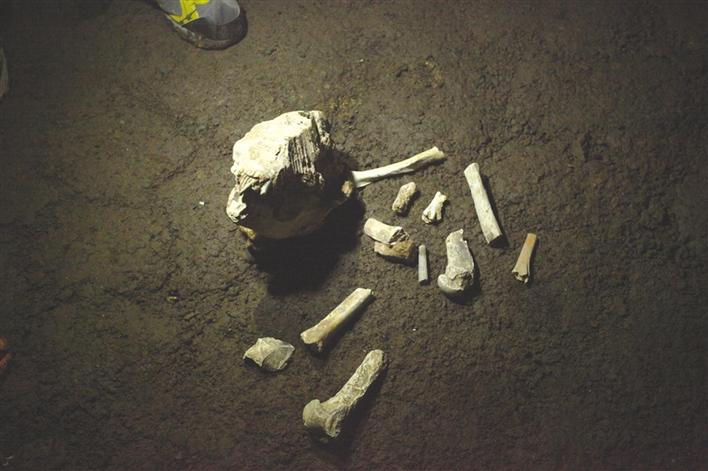
这是一张二十年前拍摄的老照片。那年,在永定区罗塔坪乡,摄影爱好者李宗功在当地人口中的“鬼洞”,发现了一些奇怪的化石。由于洞穴垮塌过,化石散落在各处。他挖出来的,有带尖牙的头骨、也有类似腿骨的断骨。
到底是什么生物曾在这一带出现?带着疑问,央视《地理中国》摄制组邀请省科考队的专家来到张家界。他们搭着双层梯,带着火把进入洞穴,不仅解开了“鬼洞”为何会在雷雨天“鬼哭狼嚎”的原因,还挖出了更多的化石碎片。最终,这些化石被带回中国科学院进行鉴定,被确认为是小种大熊猫化石。
专家表示,小种大熊猫是现存大熊猫的祖先,大约生活在3万至5万年前,是世界上已灭绝的生物。该化石的发现,也是全国首次。它的出现,填补了我国科学家研究大熊猫演化过程的一处空白,对学术界具有重要的研究价值。
文/本报记者 潘鑫 图/李宗功
This is an old picture taken 20 years ago. At that time,in Luotaping Township,Yongding District,Li Zonggong, a photography amateur,found some strange fossils in the“Ghost Cave”named by local people. As the cave collapsed sometime,the fossils were dispersed everywhere. What he dug out included skulls with canine teeth and broken bones which looked like shanks.
What on earth were the creatures in this area?With this question,the camera crew of CCTV Geography of China invited the experts of provincial scientific expedition team to get to Zhangjiajie. They climbed up a double layer ladder and got in the cave with torches,they revealed why the“Ghost Cave”set up wild shrieks and howls in thundery weather,and dug out more fossil fragments. Finally, these fossils were brought back to the Chinese Academy of Sciences and verified as Ailuropoda microta fossils.
The experts said the Ailuropoda microta was the ancestor of the present giant pandas, it lived 30 to 50 thousand years ago,this creature has been extinct. The fossil is found for the first time throughout the country. It fills up a blank in the research on the evolutionary process of giant panda for our scientists,it has important research values for the academia.
Text/Pan Xin, journalist with this Press Office Pictures/Li Zonggong